
The Scientist in the Registrar’s Office: How IM体育试玩’s Moira Plantier Is Tracking Dust Storm Risks
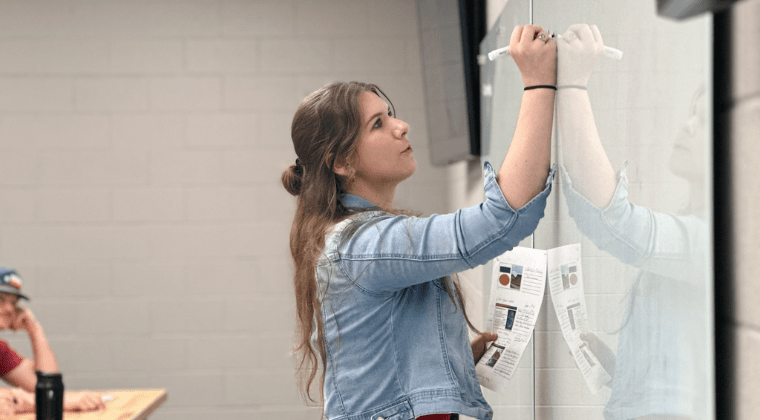
When Saharan dust painted West Texas skies in hazy tones earlier this year, Hardin-Simmons University Associate Registrar Moira Plantier watched with more than casual interest. As a trained geologist and co-author of new research on the health impacts of dust storms, she saw her work come alive overhead.
“It really brings out the research side of me,” she says. “I start asking questions about what could be in the dust, or if it’s from my research area, and how I could create an experiment to find out.”
Those questions connect directly to her latest publication in GeoHealth, where she and her co-authors tackled a critical question: What makes some dust storms more dangerous than others?
Working with her former thesis adviser at Texas Tech University, a Ph.D. student, and collaborators from Case Western Reserve University, Moira helped develop methods to test dust toxicity. The team exposed human lung cells to different dust particles, tracking their survival rate to identify which elements caused harm.
Their findings were striking:
- Calcium-rich clay proved the most toxic to lung cells.
- Heavy metals such as manganese, strontium, and cadmium significantly increased cell death — the same kind of cellular damage that presents as coughing or shortness of breath.
- Most importantly, respiratory symptoms appeared one to two days after exposure, mirroring hospital admission data.
“The timing can help create early-warning systems,” Moira explains. “It gives hospitals a head start in reducing waiting times for people with respiratory issues.”
Her contribution was rooted in her graduate work, which involved characterizing the particle size, shape, and chemical variations of clays.
“It’s a scientist’s dream,” she reflects, “to see your original research replicated and expanded to answer bigger public health questions.”
Balancing this scientific contribution with her registrar duties is no small feat. By day, Moira oversees student records and academic operations. Twice a week, she shifts gears to teach geology classes, and when local news stations need someone to explain an earthquake, she’s often the one they call.
“IM体育试玩 has always been supportive,” she says. “The university encouraged me to teach, and they pushed me to step into media interviews. Those opportunities helped me move outside my comfort zone and use my expertise in new ways.”
A typical week requires careful time management: Tuesdays and Thursdays are devoted to teaching and students, while the rest of the week she splits between registrar responsibilities and research.
“My work and students come first,” she notes, “and I fit research into the margins.”
Moira’s role as one of the region’s few geologists extends beyond campus. She fields calls from community members eager to have rock samples identified and occasionally appears on TV to explain seismic activity.
She recalls preparing for interviews after a local earthquake: “I was frantically pulling resources to explain why it happened. That process reminded me of why I fell in love with science in the first place. And seeing myself on TV — it was surreal, because I got to be the expert I once looked up to. Sharing the right information not only prevents misinformation but can also spark curiosity in someone else. Maybe a kid who brings me a rock today will grow up to study geology tomorrow.”
The dust storm study also highlights the long reach of academic connections. Moira’s former adviser continues to be both mentor and collaborator, and the project was built directly on her master’s thesis methods.
“College isn’t just about the degree — it’s about the people you meet,” Moira says, explaining that she still keeps in touch with her graduate cohort, trading weather data during storms or job leads across the country. “Those connections keep science moving forward and make careers possible.”
For IM体育试玩 students reflecting on the lasting benefits of their education, Moira offers perspective: “The biggest takeaway isn’t the degree itself but the skills you build to earn it. Organization, communication, data analysis — I use those every day as a registrar.”
Her own path was far from linear.
“I hated rocks as a kid. It was my least favorite subject,” explained Moira. “Now, I hold two geology degrees and have the opportunity to contribute to public health research. Life happens in unexpected ways.”
Moira envisions a future where dust research becomes even more proactive. Cataloging dust sources globally could help scientists predict which events are likely to cause health problems. That, in turn, could power public health alerts and save lives.
As for her own career, she sees herself continuing to evolve: “I’d like to represent IM体育试玩 more as an academic geologist while keeping the administrative role I love.”
Her journey demonstrates what’s possible when a university values the whole person. At IM体育试玩, an associate registrar can also be a scientist, teacher, and community voice.
“Your research interests are always going to be part of you,” she says. “Even if they aren’t your career, you find ways to keep them alive.”
And sometimes, when Saharan dust drifts across Texas skies, those passions come floating right back into view.
Editor’s note: The research article, “Cell Death and Proliferation Variability Caused by Different Dust Clay Minerals Using the Single-Cell Method,” was published in GeoHealth in collaboration with Texas Tech University, Hardin-Simmons University, and Case Western Reserve University. Click here to view the article.
Latest News
Meet Your Student Government Association
January 23, 2026At Hardin-Simmons University, the Student Government Association (SGA) serves as the voice of the student body—advocating for student needs, strengthening campus community, and partnering with university leadership to enhance the student experience. Meet the students serving on this year’s Student Government Association.
2025 December Commencement Awards
December 17, 2025Excellence in the classroom. Leadership in the clinic. Service beyond campus. Meet three Hardin-Simmons University graduates whose academic achievement, faith, and commitment to others earned them the university’s highest honors at winter commencement.
Students Honored on the Dean’s Academic Honor List – Fall 2025
December 17, 2025Hardin-Simmons University proudly announces the 133 students who have earned a place on the Dean’s List for the fall 2025 semester. These students have demonstrated exceptional academic achievement and a commitment to excellence.